


Seed Laws Toolbox
The Seed Laws Toolbox: a modality to address seed regulatory bottlenecks
A conducive seed regulatory framework is a prerequisite for a vibrant seed sector. Yet, in many low- and middle-income countries it is still one of the key bottlenecks for seed sector development. There may be problems, e.g. with laws and regulations not being in line with regional standards, or issues around specific topics like variety release, quality assurance, seed business licensing and seed trade. A transparent and enabling business environment will benefit all seed sector stakeholders, including local seed businesses, domestic enterprises and international seed companies. Farmers will benefit by improving their access to quality seed of improved and locally adapted varieties.
Between 2022 and 2025, SeedNL supported projects in Benin, Iraq, Mozambique, Tanzania, Uganda, and India.
Click here to learn more about our previous projects!
Seed Laws Toolbox 2026 - Closed
Call for ideas
SeedNL invites organisations, in collaboration with in-country partners, to submit ideas for addressing key seed regulatory bottlenecks. The Call for Ideas is open to organisations from the public sector, private sector, civil society and knowledge institutes.
SeedNL will support selected applicants in exploring and pursuing funding opportunities through existing Dutch funding instruments. Please note that participation in this process does not guarantee funding.
Applications will be assessed by an independent panel of experts. The deadline for submissions is 25 September 2026. Further information, including the project eligibility and selection criteria, is provided below.
Access the full call here.
Download the application form here.
The application can be submitted by email to: info@seednl.nl
Types of projects and funding
Seed Laws Toolbox projects have a budget of €30,000 to €50,000, including VAT, and must be completed within six months of the start of implementation.
All Seed Laws Toolbox projects should contribute to one or more of the following results:
A seed regulatory problem is clearly defined and/or a specific regulatory issue is addressed;
Local capacity to implement the regulatory framework is strengthened;
Relevant partnerships or networks are established or strengthened; and
Concrete follow-up activities are identified and formulated.
Eligible activities may include assessments, studies and advisory work on specific regulatory issues; workshops, training and coaching; and exchange visits. A project should contribute to addressing a regulatory bottleneck by generating practical evidence, strengthening relevant capacities and/or partnerships, and establishing a clear basis for concrete and actionable follow-up.
Eligible costs may include staff costs, travel, training and workshop costs, and other necessary material costs. The types of costs that can ultimately be covered may vary depending on the relevant Dutch funding instrument.
Focus areas
The Seed Laws Toolbox covers the following areas:
Laws and regulations
Institutional reform
Variety release
Seed quality assurance
Seed business licensing
Seed trade
Agrobiodiversity conservation and sustainable use
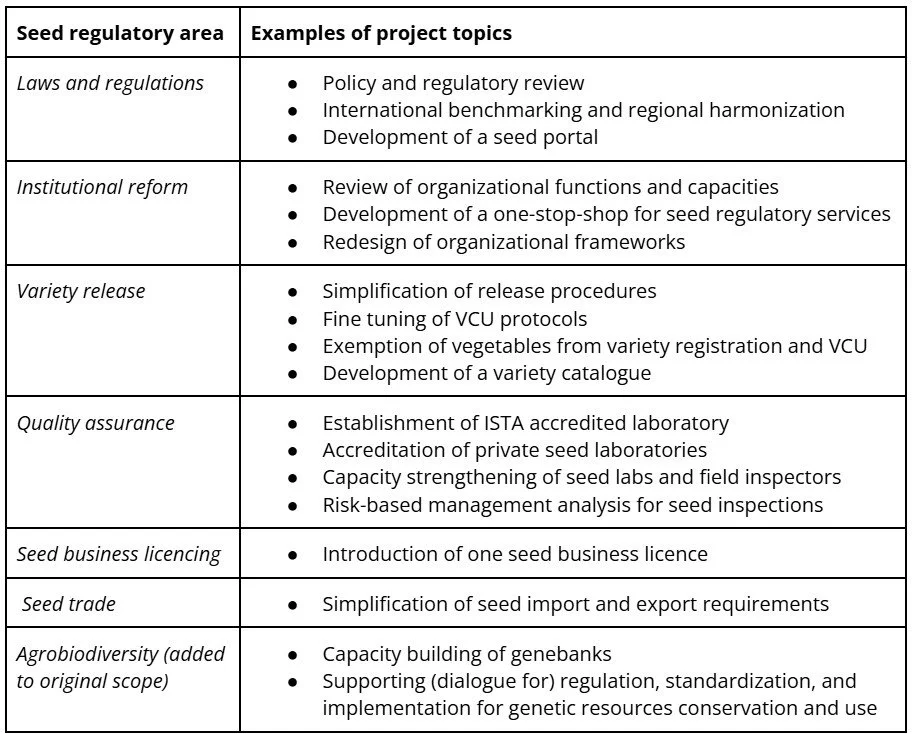
Challenges related to Plant Variety Protection and phytosanitary issues are excluded since they are addressed through other modalities and Dutch funding instruments, such as Naktuinbouw’s PVP Toolbox. Find in the table below examples of potential projects in each area; findhere a further explanation of the project examples.
[1] Examples are taken from the Scoping Study for a Seed Laws Toolbox; see Van Den Broek et al., 2020:https://edepot.wur.nl/516963
Focus countries
Applicants are encouraged to consider whether seed sector development is reflected in the relevant Dutch Embassy’s country strategy. In line with the Dutch policy focus, the Seed Laws Toolbox (SLT) is open to projects in the following low- and middle-income countries (LMICs):
West Africa: Benin, Côte d’Ivoire, Ghana, Niger, Nigeria, Senegal, Sierra Leone, Mali, Burkina Faso, Chad
East Africa & Horn: Ethiopia, Kenya, Rwanda, Somalia, South Sudan, Sudan, Tanzania, Uganda, Djibouti
Southern Africa: South Africa, Zambia, Zimbabwe
Central Africa: Burundi, Democratic Republic of the Congo (DRC)
North Africa: Egypt, Morocco, Tunisia
South Asia: Afghanistan, Bangladesh, India, Nepal
Southeast Asia: Indonesia, Vietnam
Middle East: Iraq, Palestine
Latin America & Caribbean: Colombia, Suriname
Facility management and project partners
Eligible projects should be led by an organisation from the public sector, private sector, civil society or a knowledge institute. Each consortium or partnership must include at least one Dutch partner. Collaboration with relevant stakeholders in the target country is strongly encouraged to ensure that projects are grounded in the local context.
Projects are encouraged to align with relevant Dutch sector organisations, including Plantum and NAO (Dutch Potato Organisation). Seed companies may participate as consortium partners but cannot serve as the lead organisation. Private-sector consultants are eligible to act as lead organisations.
Project teams should bring together the necessary process expertise and contextual knowledge to effectively address the regulatory issue.
Project criteria
Projects should meet the following criteria:
Focus on seed regulatory bottlenecks in LMICs;
Be implemented in one of the SLT focus countries;
Assess and build upon the local regulatory, institutional and market context;
Be completed within six months of the start of implementation;
Where relevant, take into consideration international standards and relevant seed sector indicators or indexes, while recognising that regulatory solutions need to be adapted to the local context;
Where addressing crop- or crop-group-specific issues, focus on crops that are important for food and nutrition security; ornamental crops are excluded;
Be open to participation from the public sector, private sector, civil society and knowledge institutes, with at least one Dutch entity participating in the project;
Demonstrate relevant experience in seed sector development among the consortium partners;
Involve relevant stakeholders from the target country or region;
Generate results that benefit the broader seed sector and pre-competitive domain, rather than a single company; and
Obtain endorsement from the Embassy of the Kingdom of the Netherlands in the target country.
Projects preferably:
Are public-private partnerships
Link to or build on ongoing Dutch or local seed sector development initiatives in-country
Contain innovative elements that can be piloted through the Seed Laws Toolbox
Consider how project outcomes may affect both the formal and informal sector
Proposal assessment
Proposals will be evaluated by an independent committee of experts. The committee will rank the proposals according to the following criteria:
Problem definition and contribution to an improved enabling environment in the target country/region
Project approach, proposed activities and outputs
Quality of the consortia; involving the partners in the target country/region and the right Dutch/international partners
Project budget
Criteria 1 and 2 can each earn up to 25 points and criteria 3 and 4 can each earn up to 15 points. ‘
20 “bonus’ points can be awarded for applications that:
Are public-private partnerships
Link to or build on ongoing Dutch or local seed sector development initiatives in-country
Contain innovative elements that that can be piloted through the Seed Laws Toolbox
Consider how project outcomes may affect both the formal and informal sector
Have a unique geographical focus compared to other applications
Projects will be ranked and of the projects considered eligible the highest-scoring proposals will be taken up by SeedNL to collaboratively work to attain funding from existing Dutch instruments.
Publication of proposals and project results
Approved project proposals and final project results should be published through briefs at the SeedNL website. In case of sensitivities, in agreement with the SeedNL secretariat, specific information may be kept confidential.