

Contrasting Narratives of Change
In a recent article by Fleur Kilwinger, published in the special ‘Seed Systems’ issue of Agricultural Systems, Fleur and her co-authors critically examine the narratives driving seed system transformation. In this interview we talk with Fleur about writing this article and what we can learn from this research as SeedNL community.
You can read the full article here: https://doi.org/10.1016/j.agsy.2025.104395
What was the reason for writing this article?
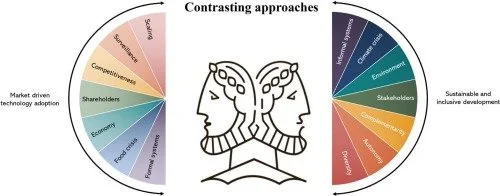
There wasn’t a predefined plan to write this article. I was asked by Walter de Boef to join the synthesis committee at the ISSD Africa conference in Kigali in October 2022. While taking notes during the sessions, I noticed the same—apparently contrasting—themes kept emerging across discussions. Later, when reviewing my notes, I found these recurring themes quite intriguing. Similar debates came up again during the concluding meetings of the NWO programme. That’s when the idea developed to write a paper that analysed these contrasting themes in-depth. We decided to focus on NL-CGIAR and ISSD Africa—both Dutch-led programmes on seed systems that I was also involved in—because they provided a coherent and relevant base for the analysis.
How was the process of writing it?
It started with seeing a pattern in my notes from the conference. Once we decided to write a paper, we needed a more systematic approach to data analysis. I dove into programme documentation rather than relying on academic articles, which often present polished conclusions. We were more interested in the ongoing discussions, which you see in proposals, posters, and conferences.
What did you find most unexpected in the results?
One surprising insight was that seemingly opposing viewpoints—which we called contrasting pair of memes—often led back to the same underlying discourse. They looked like alternatives but, in practice, were part of the same system. It showed how difficult it is to step outside the thinking of your own system and come up with alternatives. Researchers genuinely aim to promote values like inclusion and sustainability, but it’s hard to develop practical ways to implement these values because of what is called “lock-in”—being constrained by the very system one tries to change.
How does this article now influence your own work?
We didn’t find concrete examples of people truly breaking out of these discourses, but the article is a first step in making the problem visible. Many of us think we’re taking a new path, but often we end up at a familiar track. This realisation now informs my current work, where I’m looking more closely at why these lock-ins happen.
What do you hope the reader takes away from reading it?
When we shared preliminary versions of the article with peers, they often read it as a critique of the “other” side—whether market-driven or inclusion-focused. But that wasn’t the intention. We wanted to spark reflection and critical thinking about the directions we take, not point fingers. Therefore our aim has been to write the article as neutral and objective as possible. Most researchers I speak with are genuinely motivated to create change. The goal was never to criticise individuals, but to encourage deeper awareness of the systems we’re all working within, and to create more awareness around the concepts we use. We often use concepts that seem very self-evident, but that actually have different meanings to different people. We’d like to start the conversation about this and ensure that in the end we understand each other better.
