

Accelerating Food Systems Resilience in South Sudan (AFSRiSS)
Fact sheet:
Funding Instrument: RVO – Accelerating Resilient Food Systems in Africa (ARFSA)
Budget: €1.7 million
Timeline: May 2024 – April 2026
Implementors: Cooperative Dutch Coalition for Relief and Development U.A., ZOA Dorcas South Sudan, University of Juba, East-West Seed Knowledge Transfer
In South Sudan, decades of conflict have left the food system fractured and critical agricultural infrastructure in disrepair. Amid political instability and fragile governance, farmers face enormous barriers to food security, not least of which is access to quality seed. It is within this challenging context that the Accelerating Food Systems Resilience in South Sudan (AFSRiSS) project was launched. Coordinated by ZOA Dorcas and supported by a diverse coalition of partners, the initiative aims to build resilience in local communities through targeted capacity development in vegetable production and seed systems.
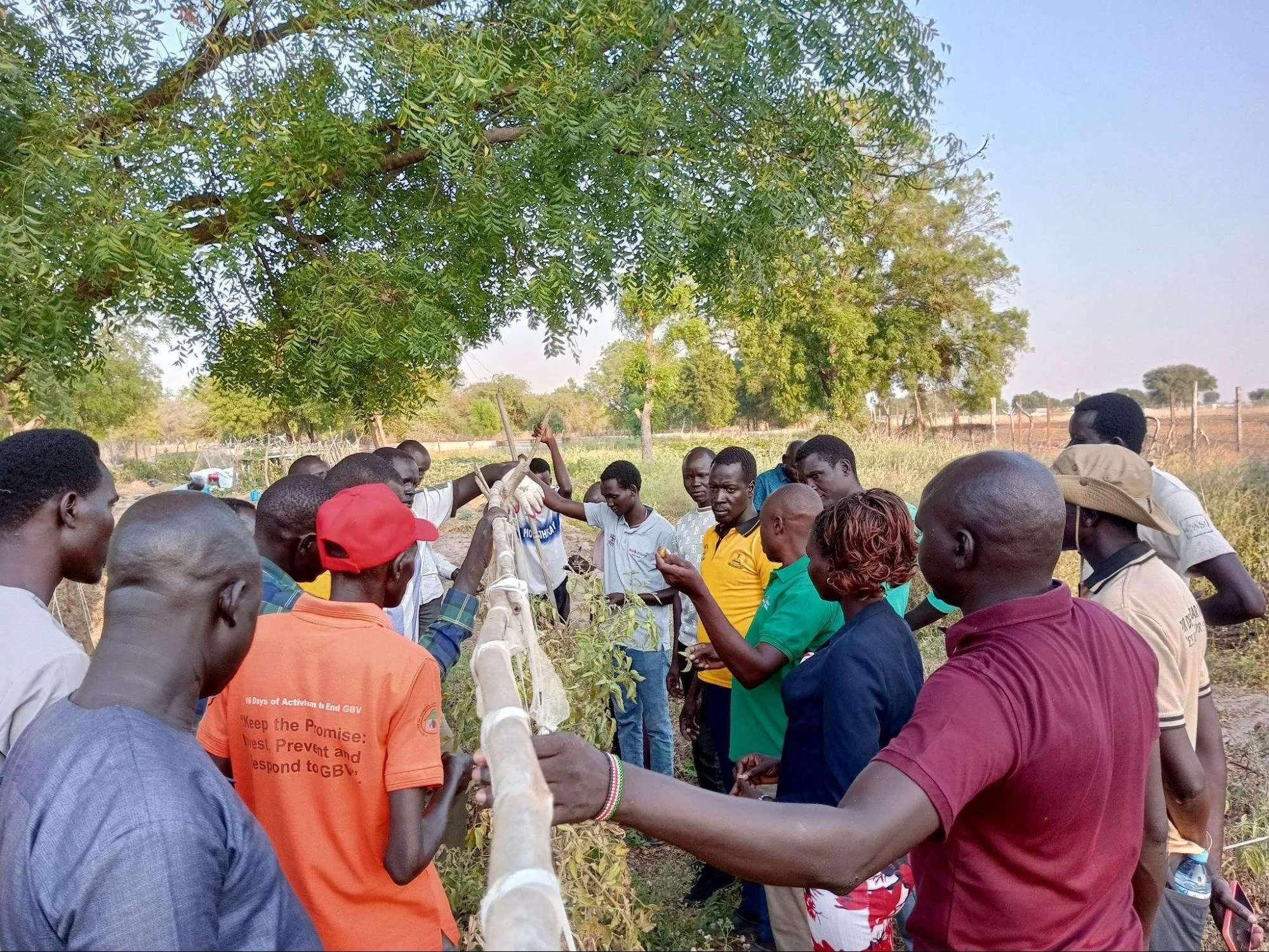
AFSRiSS operates on the principle that the most scalable and sustainable support comes from within. ZOA Dorcas is therefore focusing on scaling proven approaches to developing local seed systems, value chains, and agrifood enterprises. Within this framework, East-West Seed Knowledge Transfer Foundation is implementing a training-of-trainers model designed to equip 48 agricultural extension workers and NGO agronomists with the knowledge and tools they need to support smallholder farmers effectively. In addition to these trainers, the project works directly with 20 agro-input dealers, enhancing both their technical agricultural skills and their business capacity. These dealers often serve as the most accessible point of contact for farmers seeking advice, so improving their competencies is a strategic investment in the wider system.
ZOA Dorcas and East-West Seed Knowledge Transfer bring years of experience in supporting similar communities in the country and beyond, while the project’s academic partnerships are also key. While security and logistical concerns limit extensive field operations, the relationship with the University of Juba has enabled hands-on engagement with students and lecturers, fostering a new generation of agricultural professionals. East-West Seed Knowledge Transfer has already established two learning sites - based at the University of Juba and Dr. John Garang Memorial University of Science and Technology - with a third anticipated soon. These serve as demonstration and training hubs, bringing together theory and practice for learners across the sector.
One of the project’s early successes has been the swift adoption of training outputs, with strong engagement from both students and local actors. This has created momentum for further learning and experimentation. East-West Seed Knowledge Transfer contributes technical resources and digital tools such as the GrowHow platform and the VeggieTap for Africa app to strengthen reach and impact.
However, persistent challenges remain. The dominance of farm-saved seed (FSS) and open-pollinated varieties (OPVs), used by around 95% of farmers, underscores the limited awareness and availability of quality seed in South Sudan. Extension services are sparse, and counterfeit inputs further erode trust and productivity. These systemic gaps illustrate why agro-dealers and trained intermediaries are so crucial for spreading reliable knowledge and inputs.
The project has already revealed key lessons for seed sector development in fragile contexts. Chief among them is the understanding that quality seed is the bedrock of food system resilience. When farmers have access to good seed, paired with the know-how to use it effectively, the entire system benefits. Another insight is that direct farmer training can be an important complement to training-the-trainer approaches, particularly when extension worker-to-farmer ratios are high - as is the case in South Sudan, where one agent may serve up to 10,000 farmers. Furthermore, in this age of digitalization, using social media is essential to reach a younger audience.
AFSRiSS is still in its early stages, but its design and early outcomes reflect a deep sensitivity to the South Sudanese context. By focusing on practical, scalable interventions and anchoring them in local institutions, the project is laying a foundation for long-term impact. Its emphasis on agro-dealer engagement, institutional partnerships, and digital learning tools may well serve as a model for seed system strengthening in other fragile settings.
Contact:
Swaroop Nanu, EWS-KT
swaroop.nanu@eastwestseed.com
Mwanguhya Joshua, EWS-KT
mwanguhua.joshua@eastwestseed.com