

Impact Cluster: Onion Bangladesh
Fact sheet:
Funding Instrument: RVO via PSD Toolkit – Phase 2
Budget: €450,000 (RVO, matched 1:1 by participants)
Timeline: 2022–2025
Implementors: Advance Consulting (lead), Allround Vegetable Processing, Bejo Zaden, Lal Teer Seed, Waterman Onions, Deltadesh (consortium partners), with A R Malik Seeds and Giant Agro Processing.
The Onion Impact Cluster in Bangladesh addresses the significant post-harvest losses in the country's onion sector, which have historically reached up to 50%. These losses, coupled with a seasonal supply gap from September to December, often lead to increased imports from neighboring countries, affecting local farmers' incomes and market stability. The project's primary goal is to reduce post-harvest losses, extend onion shelf life, and decrease dependency on imports by introducing improved cultivation practices, high-quality seeds, and modern storage solutions.
In the pilot regions of Pabna and Faridpur, 27 farmers were selected to participate in demonstration plots. These farmers received six Dutch onion varieties from Bejo Zaden and two local high-quality varieties from Lal Teer Seed, free of charge. Throughout the cultivation cycle, they received training on improved agricultural practices, including pest and disease management, proper harvesting techniques, and post-harvest handling. Notably, farmers were educated on the importance of leaving longer and dry necks on onions to prevent disease and moisture intrusion during storage, significantly contributing to increasing shelf life. Traditionally, onions are often stored with their necks cut off too short to increase the amount of onions that can be stored in a bag, and the introduction of this new method required significant effort to change behaviour.
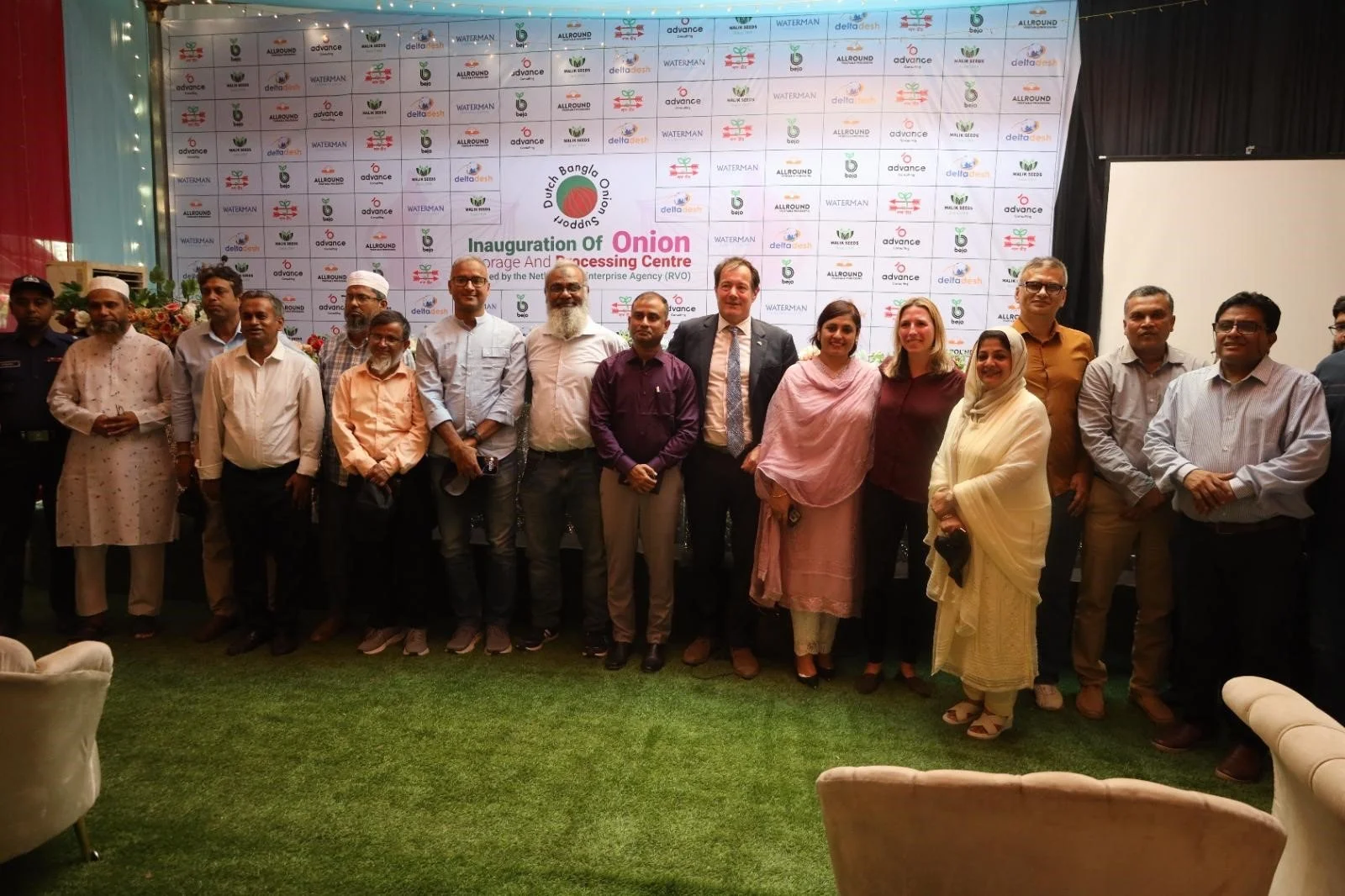
To address storage challenges, two types of facilities were established. Giant Agro Processing constructed a high-quality box-based onion storage facility in Bhaluka, Mymensingh, with a capacity of 500 tonnes. This facility, inaugurated in May 2024 by the Bangladeshi Minister of Agriculture and the Dutch Ambassador, serves as a model for modern onion storage in the country. Concurrently, A.R. Malik Seeds developed a bag-based onion storage facility in Sujanagar, Pabna, equipped with processing and storage equipment supplied by Allround Vegetable Processing. These facilities aim to demonstrate the effectiveness of different storage technologies in preserving onion quality and reducing losses.
The project also emphasizes knowledge transfer and capacity building. Training sessions were conducted for storage managers, staff, and participating farmers. Field days and open days were organized to showcase improved cultivation practices and storage technologies to a broader audience, including input suppliers and agricultural extension officers. These events have attracted significant attention, with field days drawing thousands of visitors, indicating a growing interest in modernizing the onion sector.
Partnerships have been central to the project's success. Advance Consulting leads the consortium, drawing on extensive experience from the earlier Potato Impact Cluster in Bangladesh, which laid important groundwork and offered valuable lessons that informed the setup and implementation of this follow-up initiative. Key to both projects has been the involvement of Maarten Verbruggen, Honorary Consul of the Netherlands in Bangladesh, whose longstanding engagement and network were instrumental in building trust and navigating local complexities. Collaborations with local partners such as Deltadesh, Giant Agro Processing, Lal Teer Seed, and A.R. Malik Seeds have been equally vital in addressing regulatory and logistical challenges, including the importation of specialized equipment. The involvement of Waterman Onions has further enriched the project by providing expertise in post-harvest handling and marketing.
The project has already yielded promising results, reducing post-harvest losses with 34% compared to the traditional local onion variety ‘Taherpuri’. Initial assessments indicate that the introduced local hybrid onion varieties from Lal Teer Seed are higher yielding and exhibit better storability compared to the traditional Taherpuri onion variety. The introduced Dutch varieties also demonstrated high yields, but they are more susceptible to losses in storage due to their higher moisture content. These findings have informed future strategies, with plans for Lal Teer to supply high-yielding Dutch varieties through Bejo Zaden, enabling a more tailored and flexible seed offering that provides farmers with greater choice depending on their storage capacity and market strategy.
The Onion Impact Cluster demonstrates the potential of integrated approaches in agricultural development. By addressing challenges across the value chain - from seed quality and cultivation practices to storage and market access - the project contributes to building a more resilient and self-sufficient onion sector in Bangladesh. Its emphasis on collaboration, innovation, and capacity building offers valuable lessons for similar initiatives aiming to enhance food security and farmer livelihoods.
Beyond its formal timeline, the project is already generating spin-off effects. Giant Agro Processing is exploring the expansion of its facilities, while Allround has attracted new commercial interest in its equipment. Bejo Zaden is building on the collaboration with Lal Teer to introduce more adaptable seed offerings. These developments suggest that the project's influence will persist, continuing to shape a more sustainable and competitive onion value chain in Bangladesh.
Contact:
Irma Verhoosel, Advance Consulting
Irma@advanceconsulting.nl