

Impact Cluster: Seeds 4 Change (S4C) Nigeria
Fact sheet:
Funding instrument: RVO: PSD Toolkit - Phase 1
Budget: €480,000
Timeline: January 2019 - May 2023
Implementors: NABC (Coordinator), East-West Seed, Enza Zaden, Bakker Brothers, Rijk Zwaan, Syngenta, Koppert
The Seeds 4 Change (S4C) Nigeria project was one of the earliest Impact Clusters focused on seed sector development. S4C aimed to improve agricultural yields and rural livelihoods in Nigeria’s Kano region, one of the largest horticultural hubs in the country. It reached over 50,000 farmers with its demonstration plots, and farmers participating in training in good agricultural practices saw yield increases up to 150%.
A main driver for the formation of the S4C impact cluster was demand from the Dutch private sector. Nigeria is one of Africa’s largest economies, projected to become the world’s 3rd most populous state by 2050, and already had pockets of horticultural activity and commercial interest. For participating companies, this project served as a strategic point of entry into Nigerian seed markets.
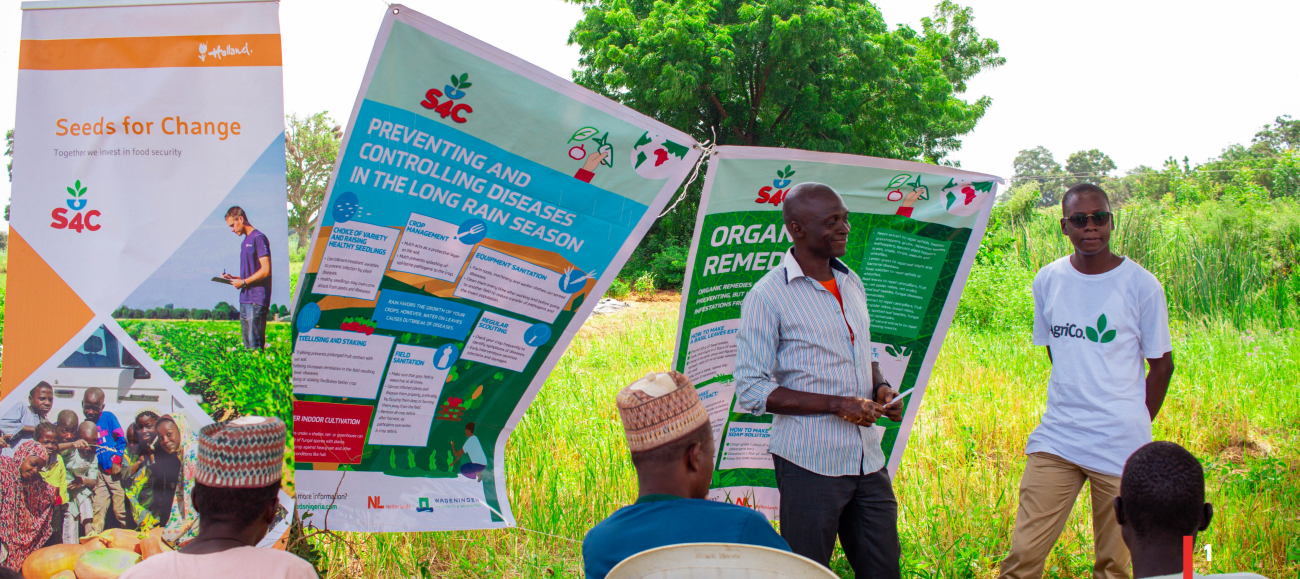
Great successes of the project laid in its engagement of farmers. Through the use of demonstration plots in collaboration with local businesses, farmers were shown the effectiveness of improved hybrid varieties in comparison to traditional varieties. As opposed to “preaching” best practices and the effectiveness of modern varieties, farmers were able to experience successes and were given the agency to choose what varieties they preferred.
The creation of informal, digital communication networks also greatly helped in building momentum for the project. Through setting up WhatsApp groups with farmers and breeding companies, farmers were invited to both share their successes and questions, spreading awareness of the success of good agricultural practices and improved seed, and establishing accessible communication channels with the breeding sector.
Some important lessons can also be learned from the project. Chief among them was the composition of the impact cluster. S4C was nearly entirely composed of competing seed companies, covering the same crops. This led to some friction in the project, seen for example in the shift from anonymized varieties on demonstration farms to branding being present when farmer demand for seed was increasing. Although collaboration remained successful, it was noted that for further impact clusters, it would be more beneficial to include either multiple breeding companies working on different crops, or different complementary companies throughout the agricultural value chain (e.g. storage, irrigation, non-seed inputs). During the projects, companies expressed the wish to have demonstration projects divided by companies rather than by crops. This has been followed up by the Nigerian Netherlands Collaborative Seed Programme demo facilities.
An interesting dynamic emerged when seeing which farmers were more eager to adopt good farming practices and hybrid seed. While changing the ways of older and established farmers proved difficult, young farmers were eager to adopt new methods. Women farmers were also seen to be much more open minded when it came to the adoption of new practices, and a retroactive recommendation was given to include strategies to more actively reach out to them from the start of the project.
A notable hurdle in the longevity of the project is seen in macroeconomic factors, which are seen as not being taken into account enough during the setup of these projects. The devaluation of the Nigerian Naira over the last few years has made the price of imported Dutch seed nearly double, causing a drop in affordability and demand, and resulting in the scaling back or even entire withdrawal of some participating companies in Nigeria.
While the S4C Nigeria project has formally concluded, its impact lingers, having sown the field for further seed sector projects in Nigeria and the Sahel.
Contact:
Mattijs Renden, NABC
mattijs.renden@nabc.nl