

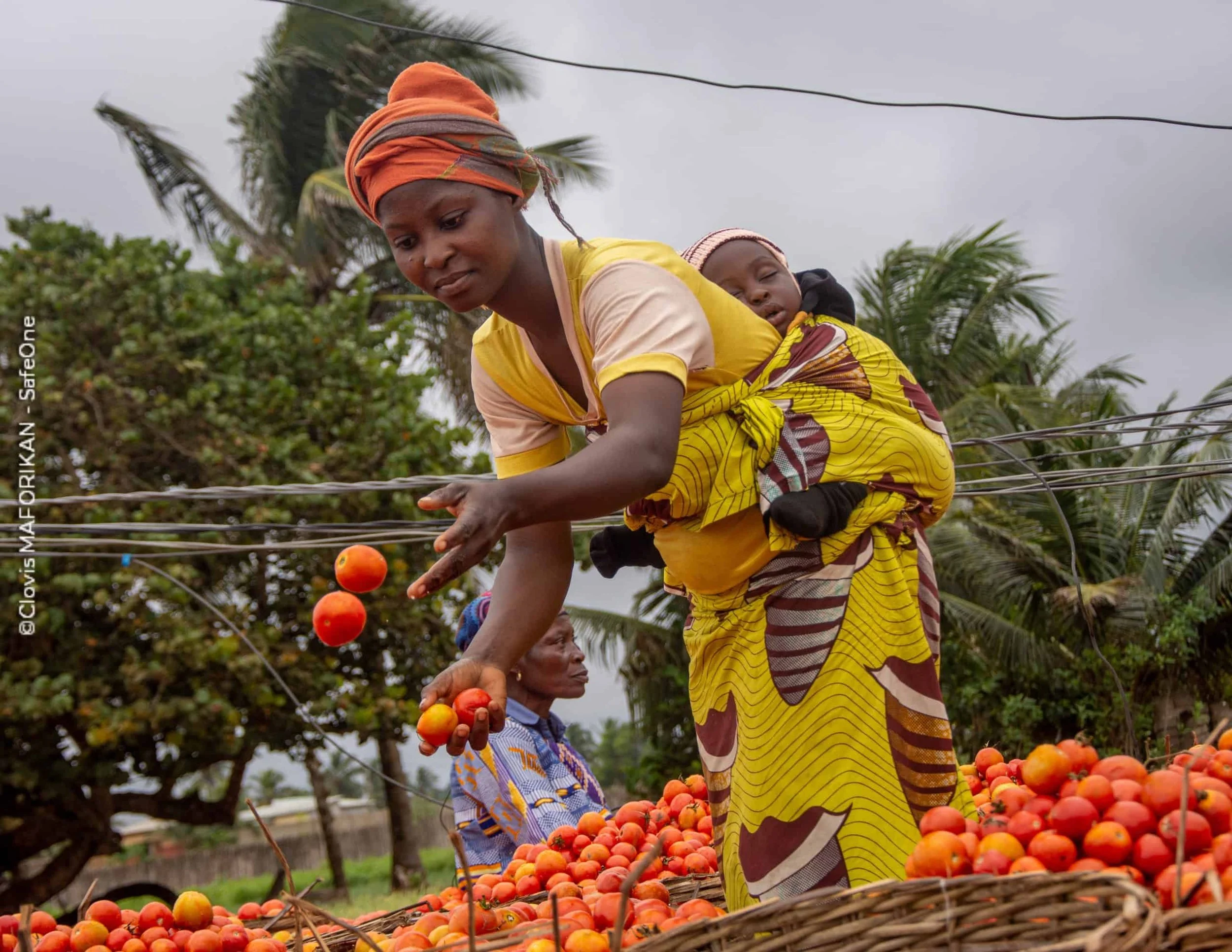
SafeVeg: Local production of safe vegetables for West African consumers
Fact sheet:
Funding instrument: DeSIRA (EU), DGIS (NL)
Budget: €8.000.000 (EU), €3.970.000 (NL)
Timeline: November 2020 - October 2025
Implementors: World Vegetable Center, CIRAD, WUR, Institut de l'Environnement et de Recherches Agricoles (INERA Burkina Faso), Institut National des Recherches Agricoles du Bénin (INRAB), & Institut d'Economie Rurale (IER Mali)
The SafeVeg project, formally titled “Local Production of Safe Vegetables for West African Consumers”, is a regional initiative aimed at increasing the availability and accessibility of safe, nutritious vegetables across Benin, Burkina Faso, and Mali. It is implemented by the World Vegetable Center, with WUR, and CIRAD, in partnership with national research institutions, regional and international collaborators, and private sector actors. The project is co-funded by European and Dutch public funds.
SafeVeg adopts a comprehensive and integrated approach to agricultural development, implemented through six interconnected work streams: coordination, stimulation of vegetable consumption, promotion of agroecological and good agricultural practices, promotion of climate resilient vegetable varieties and seed system development, business network facilitation, food environment analysis and policy engagement. The design reflects an ambition to address challenges throughout the vegetable value chain, rather than focusing on isolated technical issues. At the heart of the initiative is a commitment to partnership, involving not only private sector and government agencies, but also small-scale vegetable farmers, local community leaders, and other projects. These partnerships have been central to the project’s relevance and impact. While this article will focus primarily on the seed system component of the programme, it is important to recognize that SafeVeg encompasses a wide range of equally vital interventions across the broader vegetable value chain.
One of the most prominent achievements of SafeVeg is the revitalization of the vegetable seed sector in its three focus countries. At the outset of the programme, access to improved vegetable varieties was limited, with many outdated varieties and highly susceptible to pests and diseases. In some regions, farmers had significantly reduced vegetable production due to repeated crop failures. Under SafeVeg hundreds of new vegetable varieties, including varieties of tomato, pepper, okra, onion, and roselle, have been bred, introduced and evaluated across agro-ecologies and selected based on agronomic performance and alignment with local market preferences. Of these, 15 have been officially released in Mali, 27 in Benin and 22 in Burkina Faso.
To support the adoption of improved varieties, the project has conducted over 300 on-farm trials, enabling farmers to test these new varieties in their own environments. Additionally, more than 12,000 seed kits have been distributed as part of a demand-creation strategy, in close cooperation with local seed companies, extension agents and farmers’ organizations to ensure commercial follow-up, and avoid market disruption. Over 100 staff from seed companies have participated in targeted capacity development programmes, receiving training in areas such as seed production, quality control and assurance, seed processing and marketing. The project’s inclusive approach has also involved informal seed producers and farmer associations’ leads, especially in areas where formal distribution channels are limited.
Policy engagement has been a key component of SafeVeg’s strategy. In each of the participating countries, seed system assessments have been carried out to identify bottlenecks and opportunities. In Benin, this resulted in the development of a national vegetable seed roadmap in collaboration with the relevant authorities (e.i., national agricultural research institute, universities, seed producers, seed dealers, variety release committee and seed inspectors). Similar processes are underway in the project’s other countries. The programme has also supported postgraduate research and professional development, investing in the next generation of vegetable breeders and seed system specialists.
The project has been implemented in a dynamic context, requiring adaptation to various external developments. Periods of political instability and administrative disruption in some of the project countries have presented real challenges, affecting both the pace and modality of implementation. In response, the project team adopted a flexible approach, which included working through local organizations and adjusting funding and coordination mechanisms to maintain momentum. These experiences have highlighted the importance of responsive planning and strong local partnerships when navigating complex environments.
Several important lessons have emerged over the course of the project. First, the involvement of local stakeholders from the earliest stages is essential for relevance and long-term sustainability. Second, capacity development is not a peripheral activity but a core pillar that connects actors across the system - from research and regulation to production and distribution. Third, system-level change requires sustained effort, particularly where shifts in production practices or consumer behaviour are involved. Promoting agroecological approaches, for instance, has required attention not only to technical options, but also to knowledge sharing, trust-building, and raising awareness.
SafeVeg offers a valuable example of integrated, partnership-based development. Its accomplishments to date demonstrate the potential for lasting impact when technical innovation is combined with capacity strengthening, inclusive collaboration, and policy engagement. As the project concludes, its methods and lessons continue to inform broader efforts to strengthen food and nutrition security in West Africa through more sustainable and equitable vegetable production systems. Efforts are ongoing to secure resources for a continuation of the project, with the groundwork laid by SafeVeg offering both momentum and insight for future collaboration and scale-up.
Contact:
Marcel Beria, World Vegetable Center
marcel.beria@worldveg.org